Most people think getting in shape requires a monthly subscription, a 20-minute commute each way, and a 5,000-square-foot warehouse filled with laser-cut steel. They believe that if a machine doesn’t have a weight stack taller than a refrigerator or a dedicated cable pulley system bolted into concrete, it’s somehow “lesser.”That is a lie sold to you by commercial gym chains to justify your monthly dues.
True strength, raw conditioning, and dense muscle don’t live in a chrome-plated palace; they live in the margins of your space. Whether you live in a cramped downtown apartment or simply refuse to let fitness hijack your square footage, you don’t need an arsenal. You need efficiency.
Here is a ruthless, no-fluff evaluation of the only equipment you actually need—ranked by their Versatility-per-Square-Foot ratio—along with a blueprint on where to spend your money and a 4-week program to put it into action.
The Hierarchy: Versatility-Per-Square-Foot Ranking
To earn a spot in a minimalist setup, a piece of equipment has to pull double, triple, or quadruple duty. If it only does one movement, it gets cut.
1. Adjustable Dumbbells
- Footprint: ~2 square feet
- Versatility Score: 10/10
- Why it wins: If you could only own one item on Earth, this is it. A quality set of quick-change adjustable dumbbells replaces an entire rack of 15 fixed pairs. From heavy compound movements like goblet squats, Romanian deadlifts, and floor presses to isolation work like lateral raises and bicep curls, adjustable dumbbells unlock literally hundreds of movement patterns in the footprint of a small shoebox.

2. Suspension Trainers (TRX or Equivalent)
- Footprint: Zero floor space (anchored to a door or wall mount)
- Versatility Score: 9.5/10
- Why it wins: Gravity is the ultimate variable resistance machine. By manipulating your body angle, suspension straps allow you to scale everything from beginner rows and assisted pistols to brutal inverted rows, atomic push-ups, and core fallouts. It turns your body weight into a movable cable machine that packs into a gym bag.

3. Heavy-Duty Resistance Bands (with Door Anchor & Handles)
- Footprint: Negligible (stored in a drawer)
- Versatility Score: 9/10
- Why it wins: Don’t mistake these for flimsy physical therapy bands. Heavy continuous-loop bands provide ascending resistance—meaning they get heavier at the peak contraction where you are strongest, matching your natural strength curve. They allow for vertical pulls (lat pulldowns via a top door anchor), horizontal pushes, face pulls, and variable loading on squats.
4. Foldable/Stowable Adjustable Bench

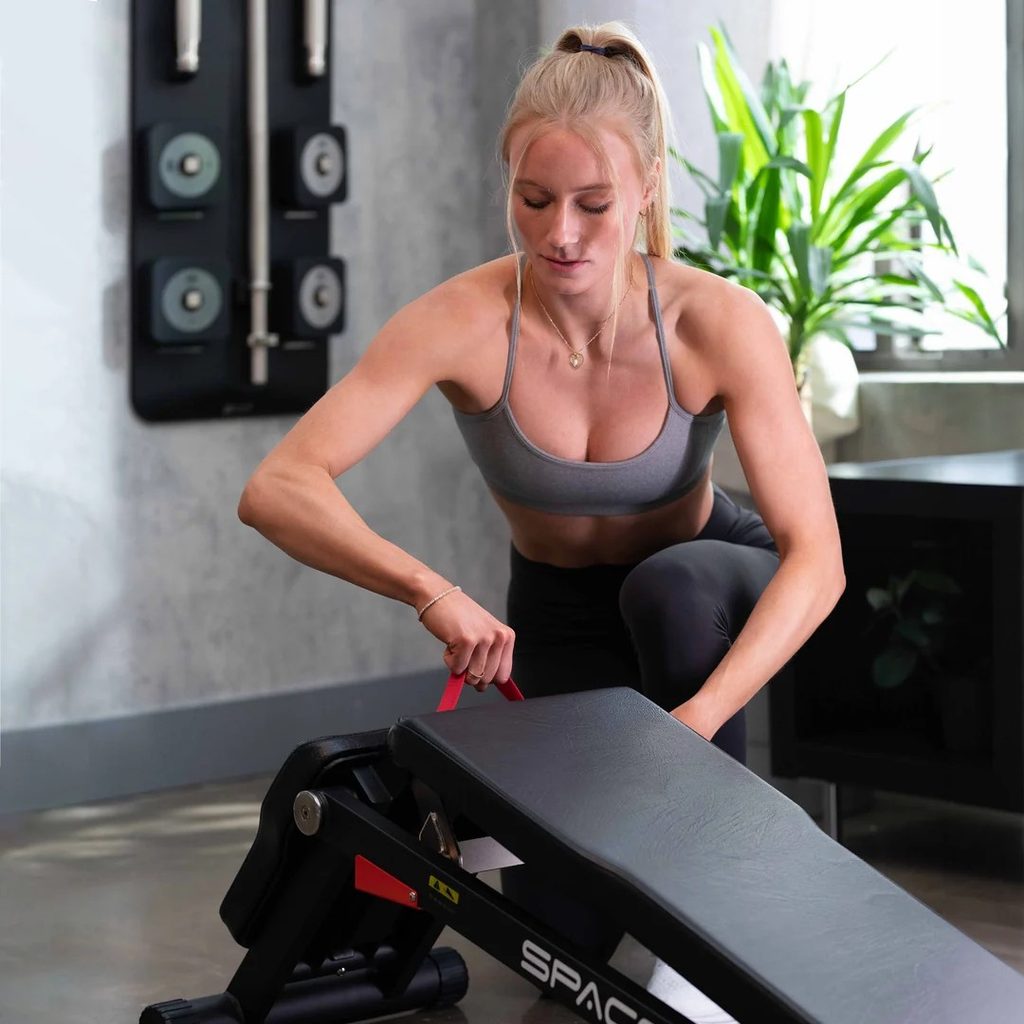

- Footprint: ~4 square feet (slides under a bed or stands vertically against a wall)
- Versatility Score: 8.5/10
- Why it wins: Floor work has its limits. A sturdy, flat-to-incline adjustable bench changes the biomechanics of your pressing and rowing angles, enabling true chest development, seated overhead work, and supported unilateral rows. A proper bench transforms a living room floor into a legitimate strength lab.
5. A High-Density Gymnastics Parallette Set (or Sturdy Push-Up Bars)

- Footprint: <1 square foot
- Versatility Score: 7.5/10
- Why it wins: Wrist health and deeper range of motion are the bottlenecks of bodyweight training. Low parallettes allow for deficit push-ups, L-sits, tucked planches, and deep handstand conditioning. They protect your joints and supercharge upper-body pushing mechanics without taking up room.
The Buy-Smart Guide: Where to Splurge vs. Where to Save
In minimalist training, gear failure isn’t just an inconvenience—it’s a safety hazard. Because you are often working out in confined spaces without a spotter or heavy safety pins, you have to allocate your budget strategically.
Splurge On (Never Compromise):
- Adjustable Dumbbells: Cheap selectorized dumbbells with plastic locking mechanisms or clunky adjustment dials are ticking time bombs. If a 50-lb weight drops mid-set because a cheap plastic tooth sheared off, you are looking at severe foot or floor damage. Buy heavy-gauge steel, machined locking pins, or proven iron-selector systems with robust warranties.
- The Adjustable Bench: Flimsy benches wobble under load. If a bench rocks when you lay down for a heavy floor-to-bench transition, your nervous system wastes energy stabilizing the furniture instead of moving the weight. Look for high-density foam, heavy-gauge steel tubing, and a weight capacity of at least 500+ lbs.
Save On (Smart Alternatives):
- Suspension Straps: You are paying heavily for brand-name nylon and branding with elite-tier suspension systems. As long as the stitching is industrial-grade, the carabiners are rated for heavy industrial loads, and the cam buckles hold firm under tension, a mid-tier or modular strap kit performs identically to a premium $200 set.
- Resistance Bands & Parallettes: Layered latex bands all degrade eventually through sun and friction; buying mid-range banded sets and replacing them every couple of years is far more economical. Similarly, solid steel or heavy PVC parallettes just need to be structurally rigid—there is no tech required here.
The 4-Week Minimalist Full-Body Blueprint
This routine utilizes an Upper/Lower split, run 4 days a week. It leverages progressive overload by manipulating tempo, rep ranges, and band tension since you won’t have an infinite rack of plates.
- A1/A2 notation means you alternate exercises back and forth (Superset) to save time and elevate conditioning.
Day A: Upper Body Strength & Mechanics
- Dumbbell Floor Press or Incline Bench Press: 4 sets x 8–10 reps (2 min rest)
- Suspension Trainer Inverted Rows (Feet elevated if possible): 4 sets x 10–12 reps (90 sec rest)
- Superset:
- A1. Dumbbell Seated / Standing Overhead Press: 3 sets x 10 reps
- A2. Banded Face Pulls (High Anchor): 3 sets x 15–20 reps (60 sec rest)
- Banded Bicep Curls superset with Overhead Tricep Extensions: 3 sets x 12–15 reps each
Day B: Lower Body & Core Dominance
- Dumbbell Goblet Squats (or Bulgarian Split Squats for higher intensity): 4 sets x 8–10 per leg (2 min rest)
- Romanian Deadlifts (Dumbbells + Banded resistance under feet if needed): 4 sets x 10–12 reps (90 sec rest)
- Suspension Trainer Single-Leg Hamstring Curls: 3 sets x 10–12 reps (60 sec rest)
- Superset:
- A1. Parallette L-Sits (or Tuck Holds): 3 sets x Max hold
- A2. Banded Pallof Press (Anti-rotation core): 3 sets x 12 reps per side (60 sec rest)
The Weekly Schedule:
- Monday: Day A (Upper)
- Tuesday: Day B (Lower)
- Wednesday: Active Recovery (Long walk, mobility work using suspension straps)
- Thursday: Day A (Upper)
- Friday: Day B (Lower)
- Saturday & Sunday: Complete Rest
How to Progress When Weight is Capped:
When your adjustable dumbbells max out on a movement, don’t panic. Apply these intensity multipliers:
- Tempo Control: Take 3 full seconds on the eccentric (lowering) phase of every lift.
- 1.5 Reps: Perform one full rep, half a rep at the bottom, and count that as one.
- Mechanical Drop-Sets: Move immediately from a harder variation (e.g., feet-elevated suspension row) to an easier variation (foot-supported row) with zero rest.
Stop waiting for the “perfect” setup or a bigger budget. Carve out a 6×4 foot patch of floor in your living room, lock in your gear audit, and realize that mastery doesn’t require a commercial facility—it requires intent.
Optimize Your Training & Nutrition
Explore our interactive tools designed to fine-tune your performance and track your progress.
 Adam Hawk