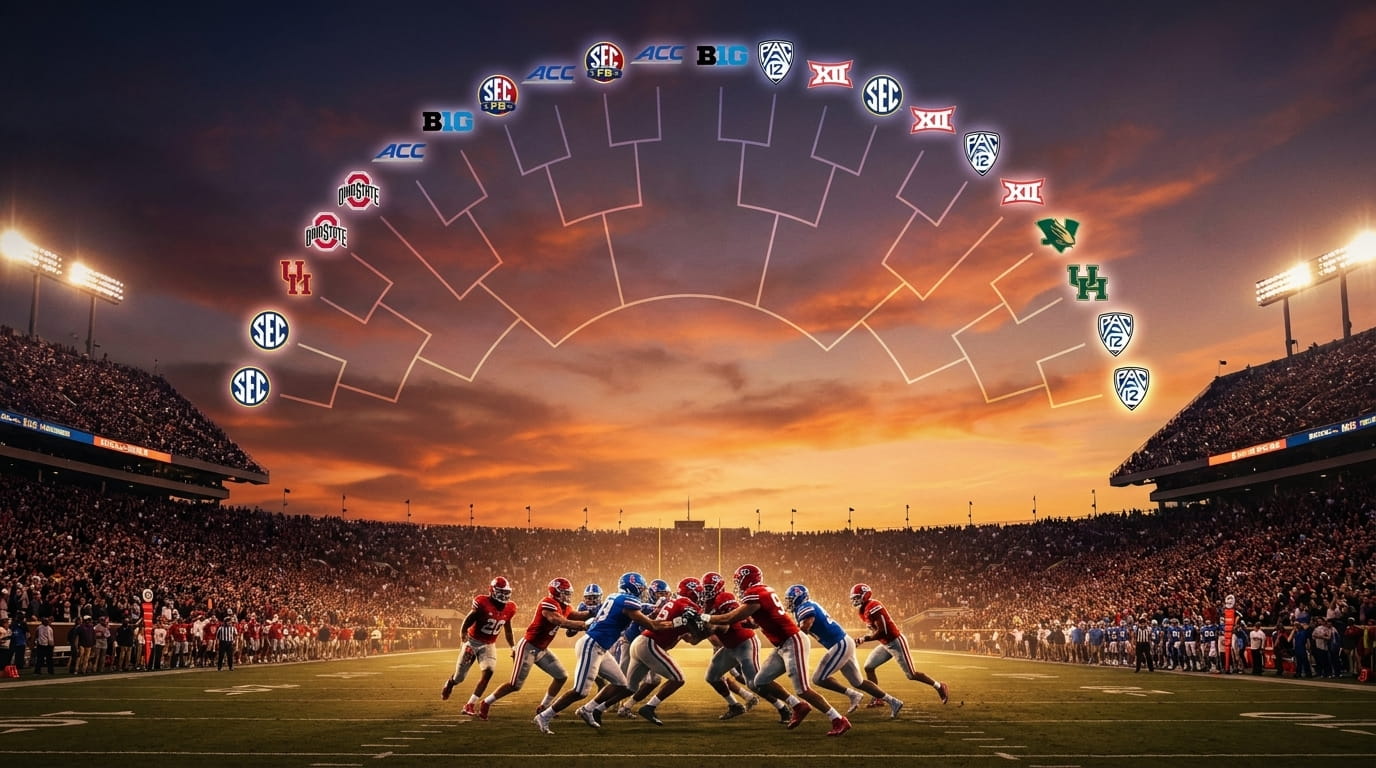
The End of the “Four-Team Era”: College Football Teeters on a Massive Expansion
For a decade, the College Football Playoff (CFP) operated with the clinical, often controversial efficiency of a four-team exclusive club. It was a gated community where only the pristine survived, leaving a trail of “what-ifs” across the country every December. That era is not just fading—it is rapidly approaching a total overhaul. Whispers from behind closed doors suggest that the sport is moving toward a massive 24-team bracket, a structural shift that threatens to fundamentally alter the DNA of the collegiate game.
The latest reports indicate that momentum for this 24-team expansion is no longer just idle speculation. Power brokers in college athletics are sketching out a timeline for a format that mimics the wide-open chaos of the NCAA basketball tournament. For fans who have grown tired of seeing the same four blue-blood programs monopolize the postseason, this news is the equivalent of opening the floodgates.
Why 24 Teams? The Math of Inclusion
The shift from four teams to 12 was the first step toward democratization, but 24 would represent a total capitulation to the “more is better” philosophy of modern media rights. In a 24-team model, the sport moves away from the “beauty contest” style of subjective committee rankings and toward a system that rewards depth and consistency across a larger swath of the country.
Consider the stakes for the average program. Under the old four-team model, a single loss in September could effectively kill a championship dream. With 24 spots, the margin for error expands significantly. A program like an Ole Miss or a Penn State—teams that have historically hovered just outside the elite circle—suddenly find themselves in the driver’s seat for a postseason run. The pressure shifts from “don’t lose” to “stay relevant.”
The Human and Physical Cost
While fans may salivate at the prospect of a bracket that lasts through January, the physical toll on student-athletes cannot be ignored. A 24-team playoff means teams could potentially play as many as 16 or 17 games in a season. In a sport where the physicality is designed to break bodies, adding nearly an extra month of high-intensity play turns the postseason into a war of attrition.
“The playoff isn’t just a tournament anymore; it’s an endurance test. The champion won’t just be the best team—they will be the team with the most depth and the healthiest roster in late January.”
Coaches will have to rethink how they manage conditioning and recovery. The traditional “mid-season grind” will now feel like a light warmup compared to the tactical requirements of a deep postseason run. We are likely to see more aggressive roster rotations during the regular season, as teams prioritize keeping their stars fresh for the late-winter push.
The Road Ahead: What This Means for You
If the rumors hold, the landscape of college football will undergo its most radical change since the inception of the bowl system. The significance of the “regular season” will likely shift. Games in October, which were once considered “must-win” survival matches, might become strategic positioning games to secure a first-round bye in the expanded bracket.
For the everyday viewer, this is a win for accessibility. You’ll have more meaningful games, more upsets, and more opportunities for Cinderella stories. Whether the product remains “college football” as we’ve known it, or evolves into a professionalized, high-octane spectacle, one thing is certain: the era of the exclusive four-team club is dead. The next few years promise a chaotic, sprawling, and exhilarating future for the sport.
As the timeline for this expansion firms up, the focus will turn to how the bowl games—the traditional bedrock of college football—will survive in a landscape dominated by a massive, centralized bracket. But for now, the message is clear: the path to the trophy is about to get a whole lot longer.
Optimize Your Training & Nutrition
Explore our interactive tools designed to fine-tune your performance and track your progress.
 Adam Hawk